

This week in yoga, I have invited students to think about what “making space” means to them. I say it a half-dozen different ways to refer to the physical body–“open,” “extend,” “stretch,” “reach.” And this week, I invite them and myself to get in touch with “making space” mentally, emotionally too. So what does that even mean? It might mean allowing oneself to experience the types of “negative” or “bad” states of mind we wish we didn’t experience. It might mean allowing oneself to see a difficult truth about another person. To one student, it meant looking at their anxiety/fear around a medical appointment. “Making space” meant opening to the idea that this appointment would not be a repeat of a past, very negative experience, but would be its own experience. How else might we think about this?
For me, “making space” often means noticing the feelings or thoughts I’m pushing away or avoiding, and allowing them to be present even if they are deeply unpleasant. This is actually an integral part of a yoga practice to begin with, but it tends to be a part that people think they are “doing wrong.” There’s a real stereotype out there, thanks in large part to the way yoga is marketed in the U.S., that one is to spend the entire yoga class “feeling good” in a way that refers to enjoyment, pleasure, happiness. If someone goes to a class with that impression, and finds themselves physically challenged in a way they don’t enjoy, or finds their mind stuck on something stressful, or experiences all the things they’ve been pushing away–their partner pissed them off, they forgot the pet food, their house is a mess they still haven’t gotten around to, they don’t want to cook dinner later, they hate their job, they have a terrible relationship with their body, they have painfully dysfunctional thought patterns–they can spend the whole class convinced that they can’t do yoga or they don’t get it. In my observation, this results in people avoiding yoga because they think they have to already be in some correct or ideal state of mind to do it. The fact is, the truth of our state of mind, the truth of our experience and where we are that day, in that moment, is exactly the state of mind that belongs in yoga. Whatever it is. (Keeping our external expressions within the bounds of our mats, of course.) If you will, make some space in your mind for a bigger idea about what a yoga and mindfulness practice is really for, and why all the “wrong” states of mind and body are exactly the right things to experience in yoga.
Yoga is about non-attachment (Vairagya, in the ancient Sanskrit of the Yoga Sutras of Patanjali) and release. But this is difficult. Sometimes we have to notice what it is we are attached to, notice how hard we hold and work to keep it, maybe for a long time, before we are capable of ever resolving our problematic internal states. This might mean spending many yoga classes experiencing our painful emotions and our irrational or dysfunctional thought patterns and/or physical problems. I have gone to the mat bitter, sad, confused, resentful, depressed, distracted, limited by physical injuries, feeling ugly, feeling like a rotten pile of failure. But the point is I went to the mat. And I strengthened and stretched my angry, ugly, hurting, failure of a Self using the same movement patterns and postures I used to strengthen and stretch my joyful, beautiful, vibrant, unstoppable Self. The fact is, they are one and the same Self, separated only by my own judgments. These are distinctions and boundaries that I invent. Only by bringing the “bad” pieces to the mat over and over (and over and over) again did I come to this realization. As ever, you won’t really feel this just from reading it here or anyone telling you. You have to DO it, by and through your own whole and perfect Self.
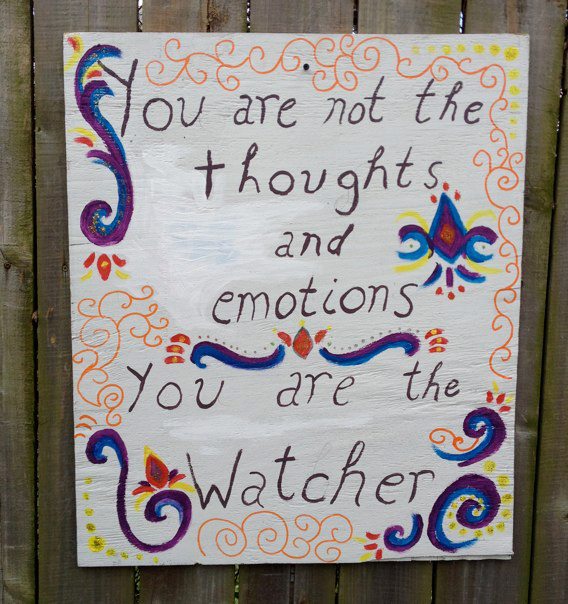
In meditation, I often invite students to imagine their thoughts and emotional states as clouds in the sky. If we watch the sky, the clouds will change in shape, size, color, and their very nature. A clear and bright day can turn to storms very quickly. Just like weather, even though they may come in seasons and patterns, all our thoughts and emotions are passing through. Their fundamental nature is to be temporary. If we can visualize our thoughts and emotions as the weather above us, and our Selves on the ground watching, we are able to understand more clearly their true temporary nature. Seeing this, putting our Selves in the position of an observer rather than as helpless to the storms, we take away their power. We relieve our Selves of the work of constantly blowing the clouds away or running from them. Often, that discomfort we encounter about being in a yoga class, about what we “should” feel like, is us trying to control our inner weather, rather than sit with it and allow it to be temporary.
Another way to think of making space has to do with the “good” thoughts and emotions. I have mentioned my common thought pattern of minimizing, or discounting/devaluing the positives. It’s common in a lot of people (me) to have a thought like, “I look GREAT today!” or “I did an amazing job!” and instantly turn away from enjoying that feeling. “Yeah but yesterday you had that awful zit,” or “Big whoop, it’s ONE day, it’s not like you just look great.” “Not so amazing considering how you fumbled through the entire thing until the very end.” Maybe we turn toward a negative expectation of the future. “Yeah but the next project is gonna be a real shitshow, you know you’re in over your head.” For me, in all of these cases, maybe it comes from resenting the temporary nature of the good feeling so I cut its time short. Maybe I would rather pretend that feeling good doesn’t matter to me than accept the truth that feeling good will pass, just like that bright clear sky will eventually cloud over. What if making space also means opening up, softening to the full experience of our joy, beauty, happiness, power, and prosperity? Accepting it, being in those moments while they last, allowing them too to be impermanent?
I’ll part on a favorite Buddhist quote that I first saw in 2013 at the wonderful Louisiana Himalaya Association in New Orleans, LA. I loved it so much I took a picture.
I breathe.

 The Sassafras Cottage