Sober September and Self-Awareness

“So, first follow the truth, and then the truth will follow you.”Yoga Sutras of Patanjali, Commentary by Sri Swami Satchidananda, 2.36

If you have taken any of my yoga classes, you have probably heard me say that yoga is more than the physical practice, and you’ve done some simple mindfulness exercises. You might have heard me talk about vairagya—non-attachment. Hopefully you felt encouraged to make effort for its own sake, without clinging to the thought of that ideal outcome. Vairagya is one of many fundamental concepts in yoga that originated in ancient texts like The Yoga Sutras of Patanjali. My goal is always to connect my yoga practice and teaching to its roots.

With that goal in mind, this entry is inspired by the Yoga Sutras. The Portion on Practice introduces all eight “limbs” of yoga, of which the physical practice (asana) is only one. Listed before asana are the yamas—moral restraints, and niyamas—moral observances. Truthfulness, or satya, is one of the yamas. Swadyaya, or self-study, is one of the niyamas. My experience has often found these two concepts close together. Swadyaya means study of a spiritual nature—spiritual texts, for example. It is important to recall that yoga is “the journey of the self, by the self, through the self.” Therefore, the study of spiritual texts should be an inward study of what the reader sees or takes from the texts, aka “self-study”. To be able to observe our self in this way requires self-awareness, but more importantly, self-honesty. As I decided what this blog entry about alcohol abstinence should be–what to include and what not to include–I feel the pull to make my drinking habits sound or seem a particular way. The thought in the back of my head says there is nothing unusual in the quantity or frequency of my drinking, so why look too hard? The presence of this thought indicates to me that it’s actually extra important to engage this process and the words I create around it with a commitment to satya.

It normally takes a human body about five days to get past all the aftereffects of even one day of drinking alcohol, and now I’m just past the halfway point. I know that my body is done eliminating any alcohol byproducts, and that the thoughts and feelings I am having are not directly due to the influence of those chemicals or processes.

Before I started abstaining from alcohol this month, I was consistently having several (2-6 with high variability) beers 3-4 nights per week—more than recommended, less than the amount it takes to give me a hangover. As in a typical swimming pool season, I also had several binges over the course of the summer, the kind that create slow mornings and an entire day’s worth of junk food. My habit is definitely enough to have persistent effects on mood, including anxiety and depression, which can turn into a self-reinforcing cycle and which eventually becomes alcohol addiction in many people. I’m glad to be giving myself this gift of increased awareness this month, these opportunities to notice my impulses to use alcohol, and to observe any physical, mental, and emotional changes.

States of Being

I have seen dramatic changes in my income and employment since March. The search for decent work is discouraging. I live in a college town, and our transmission rates are going up and up no matter how many people I don’t hug—which I miss to extremes. Building a portfolio in freelance writing means getting paid garbage for excellent and careful work. I have significant and shifting community service commitments that I constantly feel like I’m not quite living up to, and I internally insist on comparing my responsibilities to my friends who have jobs AND kids in these uncertain circumstances. (This is the part where I dismiss the legitimacy of my own feelings of stress and belittle any work I do accomplish.)

Suffice it to say, I know I’m not the only person who has been following substance impulses more regularly. The amazing thing about my years of mindfulness practice is that I have practiced satya enough to be genuinely more honest with myself, which means I can actively notice this behavior. And if I can notice it, I can decide whether it aligns with what I understand as my highest good. And if it doesn’t, I can choose to make a change. The truth is, it’s all me.

I want to remember that when I feel a lot of responsibility, alcohol seems to expand my capacity to “just keep swimming” and not get stuck or talk myself out of my tasks. Is that false bravado I create, or does using alcohol actually dull the edge of my toxic perfectionism? The truth is, this is difficult for me to discern. I think my task right now is to witness that negative perfectionism in all its deadly glory and perhaps strategize different ways through it. I know that suppressing and avoiding my internal states is as damaging in the long run as alcohol is damaging to the body. I have a book that refers to meditation as hygiene for the mind. Maybe I need to commit more time to tidying up. This is exactly what some yoga-isms say—that if you “don’t have” ten minutes to meditate, that means you need an hour. I meditate, but maybe I need to build in some extra.

Impulses

My “Have a drink to wind down,” impulse is significantly lower than it was. For me, it only takes a day or so for that thought to fade into a type of background that I easily move beyond. I feel relieved at that. It feels like I can be assured that I don’t have physical dependence on alcohol. I have never had to take a drink in the morning to stop my hands from shaking or to get going, but I think physical dependence is much more subtle than that for a long time. The mind will tell us a lot of things to get us to behave in a way we have taught it to depend on. And that includes creating intense “want” for a drink and rationalizing of behavior long before it creates a physical “need”.

Thinking back to last Sober September, this socially distanced version is neither harder nor easier. Last year, I ran a gauntlet of social outings while sober—a birthday dinner, a brunch, a concert—and it wasn’t a problem. This year, there are a handful of back porches I visit, and like last year, it doesn’t bother me to be around other people who are drinking. I also don’t feel like I want to drink to stave off loneliness or boredom. I like having this knowledge, a lot. It means I have the space to do whatever I would be doing, and that I don’t choose to drink just because everyone else is. It means my friendships are built around true enjoyment of the people I want to spend time with, not mutually convenient proximity to a substance we like.

I feel the alcohol-sugar connection very acutely. I REALLY WANT sweet drinks like sodas, desserts, more honey with my breakfast—there are brownies baking in my oven as I type this sentence. Because my goal is Sober September, not Sugarfree September, I am indulging in an extent of sweets that I normally don’t. (Sidenote: I wonder if simultaneously quitting alcohol and sugar cold turkey isn’t a major diet saboteur for people with weight loss goals.) My usual 12 oz. light beer has 95 calories, which means I had been enjoying about 1600 calories per week in beer alone. That is almost an entire day’s worth of calories, y’all. Meanwhile, one brownie has between 130-200 calories depending on serving size, and a soda has about 140 calories. I’m able to satisfy my sweet tooth with only one treat rather than several beers, so I’m reducing those extra calories to about 25% of their Peak Beer total. One of my goals going forward will be to maintain awareness of those alcohol calories and remind myself that it really is extra sugar. It’s not good for my health for that reason alone.

What’s Different

I’ll start with the one that stands out to most people who try alcohol abstinence—deeper sleep. Alcohol does depress the central nervous system, which makes falling asleep feel like it’s going to be deep sleep. But its diuretic properties make me more likely to wake up to pee, and can cause that to happen more than once. The other thing that will wake me up is the point when my body converts all that alcohol into energizing glucose. The “sugar high” part of alcohol is slower to set in, but just as pronounced as if I ate four brownies instead of drinking four beers. So some nights of moderate drinking and a reasonable bedtime, I would get up to pee and then stare at the ceiling for an hour or two.

Alcohol has been shown to decrease the number of REM cycles the brain completes in a given night, which means less restorative sleep even if you are not conscious. You (I) physically and mentally recuperate from life less if you drink routinely. We know a lot now about the profound damage sleep deprivation can cause, so I want to commit to understanding my sleep as precious time whose quality I want to protect. Yoga and meditation go a long way, but so do my choices of what to put into my body.

I notice that my coffee works better in the morning. This might be entirely due to being better hydrated—another benefit of reducing alcohol—or it might be that my brain is more prepared to be alert because I am fully rested. Either way, the caffeine feels like a nice perk I give myself for getting halfway through the morning instead of a necessity to make my thoughts come together.

I feel more aware of my core when I work out. This could again come down to hydration, but it could also be neural pathways functioning better because my digestive organs aren’t so busy processing alcohol and its byproducts. My waist and belly feel smaller, which I think is bound to be related to the lower net sugar intake. I feel like I am able to do core and ab exercises more effectively, and that they are paying off more. Is this because my body is better at muscle repair with the better sleep? Is this just a self-serving perception I created because I want there to be vanity benefits of giving up alcohol? I’m not sure. Self-study often reveals the places where I lack understanding of my own behaviors or motivations, and that’s why it’s important.

What I Want To Keep

I want to keep it casual with alcohol. I want to work hard in my garden, on my horse, at my computer, and on my yoga mat. And sometimes I want to crack open a cold beer when I’m done, but I don’t want my anticipation to feel pronounced. I want to raise a glass because of joy and deliciousness, with nothing to hide, to not become attached to the thought of when I can have the next one.

Last year, I didn’t set future goals about my drinking. This year, I think it’s very important to spend time considering what I think is ideal in quantity and frequency. It’s important to sit with the truth of my awareness, even if what I see there is uncomfortable.

My meditation practice was really strong in March when I came home from Advanced Yoga Teacher Training in Guatemala. I felt afraid of the uncertainty, but powerful and fearless. I spent a lot of time listening to songs about Light. I thought y’all might like this one, which is really about the truth.

Thank you, India.
On Joy

Pandemic, self-quarantine, unrelenting existential dread. How could 2020 possibly be a joyful year, at this point? I could tell myself all the stories about why now is not the time to write about joy, put this aside. Or I can write what I know, beginning with the fact that Joy is whole and complex just like everything else.

I think that Joy is most profoundly felt in people who have learned non-attachment. Non-attachment, vairagya in yoga, means participating in life and making efforts for their own sake, with no expectation of any certain outcome. This is hard for us. We don’t want to “waste” our efforts, we want to control the quality of our outcome by purifying the quality of our efforts. We think if we go to yoga in the perfect frame of mind, with the perfect intention, then we will do every pose perfectly, and feel perfect later. Then when we find ourselves imperfect to begin with, we don’t go in to the class because our “head is not in the right place.” But that’s not how effort and purifying work. Sometimes, even with serious consequences at stake, our most valiant effort is followed by devastating failure. Sometimes we’re physically caring for someone we love with a terminal illness, knowing they will die and we can’t stop it. Or maybe all our plans and income fall apart because of a global disaster.

Personally, I finished a bar exam two weeks before my father took his life. I was VERY attached to how good it would feel to tell him that I passed, because I built a lot of toxic perfectionism around the frame of pleasing him in a particular “first child achiever” type of way. My feelings when I did find out I passed, were pretty fucking complex. I did a lot of letting go that year, whether I recognized it at the time or not. When we scattered his ashes at Cape Flattery in Washington, there were warm and Joyful family moments that only we shared and I will never forget. What I know now is, to be able to make my biggest, realest effort, purely for its own sake, requires a LOT of self love. It also requires the “awareness in the present” that mindfulness practices cultivate.

My 2020 had some hard moments around the time we should have been advised about the COVID-19 emergence. Unrelated to the earliest signs of the global pandemic, my friend died after a two-year battle with ALS. ALS is a heartbreaking thing to learn about when you learn that someone has it. She was my friend through her son, a dear person to me, who I never felt I could help or comfort as each new day, week, month brought new stresses and pains. He was able to do his job remotely, so he and his sister both moved back to Mississippi to be able to spend time with their mother and take care of her. In 2018, when she could still walk, and could speak, he invited our small group of Soul Friends to spend the weekend with her. We all got to be together, which we hadn’t managed in many years of jobs and marriages and kids and moves. We got to have deep and truthful conversations about what we have meant to each other over this time, and we got all the hugs and back rubs and dog love. We cooked together, and worked on nutritious, soft foods she could swallow. Her birthday is three days after mine, and I made a lemon Charlotte Russe and a winter vegetable risotto that she really liked. I cried as soon as I smelled the inside of her house, and I wanted to cling to every second, to her, to my people. We all took a long walk by her creek with her and the dogs, and held onto a big group hug before we left. I cried for the first half hour of the ride home when we had to leave.

In January of this year, we returned to that family home, for the first time without her. She had demanded a Celebration of Life as a service. In the cold and sun, we set up all the spaces to host visitors, and painted and crafted, cried and chatted. At night by the fire pit, we worked on the music for the service, and had epic dance parties with all our songs from back when. Personally, I think exuberant dancing should be prescribed during hard times. I think it calls Joy up into the body and mind. During the Grief Dance Parties, we dropped to the ground to pump out pushups, screamed out all our power songs, stomped, opened and moved our hips, cried, hugged, had rapid-fire conversations about any and everything. We BREATHED. Hard. I learned a lot about my friend from conversations with others who knew her, and I got to know people in her family who I had never spent most-of-three-days with before. Every person was in pain, noticing her absence, seeing her tiny dog and constant companion continue to look for her, wondering and worrying about the immediate family. But our collective presence and attention was vital, healing, and Joyful.

All of that openness sent me on a hard wave of passing back through my grief at my father’s death, which I knew it would. But it did it in an unexpected way this time. We sang Joan Baez’s “Let Your Love Flow,” at the celebration, which I put on when I got home. Her version of “The Water Is Wide” was our family song when “our family” meant both of my biological parents and my sister. We each had a verse, and harmonies. Dad played guitar beautifully. I probably haven’t listened to that song since my Dad’s service, or shortly after. It hurts so much. So in the early winter, as I felt that hurt, and breathed, and stayed open to it, I realized that although my Mom is alive and thriving, and I get to hear her sing and sing with her somewhat regularly, I haven’t heard her voice on that verse since the last time we all sang “The Water Is Wide” together. I’m not sure when that would have been, exactly. But one time, I heard the sound of our voices together for the last time. Would we have put our efforts into that sound in a different way, if we had known? Would we have been less open, the sound less intimate, if we had thought to protect ourselves from the grief we have all now been through?

Joy, as I think of it now, does not mean “euphoria” or “ecstasy,” which to me imply de-connecting or detaching. Those may appear alongside Joy in some moments, but they are different from it. Joy tends to appear in clarity, and it often accompanies pain. Ursula K. LeGuin describes Joy as “gladness without reason” in The Left Hand of Darkness. In the novel, the two main characters are on a difficult and depriving journey. They have only day in and day out of maximum effort with not enough provisions. The novel’s main focus during this time is the characters’ development of a close friendship and deep affinity for each other. Their relationship is described as particularly special, containing a shared experience of Joy that cannot be replicated after they accomplish their mission and get back to civilization.

In music, Joanna Newsom’s extraordinary “Time, As A Symptom” is full of lyrical gems, one of which describes “the nullifying, defeating, negating, repeating Joy of life.” I find truth in these sentiments, that real, genuine Joy often comes at the cost of great effort and loss. That the basic experience of Joy does not depend on comfortable or “happy” circumstances. Joy is connection without attachment. Euphoria and elation imply a dizzying lift away from connection that is gone as soon as the immediate feeling is disrupted. Euphoria and elation and ecstasy are delicate. Joy is powerful. Newsom’s song also says

The moment of your greatest joy sustains
Not axe nor hammer, tumor, tremor
Can ever take it away, and it remains
It remains

Joy is indestructible. Memories of joyful experiences can be some of the most vivid. Joy can feel like profound self connection, or mutual connection. It is a type of intimacy. It requires openness to one’s Self, and to others’ Selves, and humans love these feelings. Joy hangs around the corner from grief and pain because we need it to survive life’s inevitable griefs and pains. Joy shows up to lift us and remind us of Love. What I know now is that the end of a single experience of Joy is not its destruction. It remains, accessible in the clearest and surest parts of my memory, and probably around the corner from the next disaster.

Because I want to leave this with something strong that you can dance to, and I hope you will.

My Mindful Week: At The Core

This week, I stole several aspects of the physical yoga practice from Southern Star Yoga Center’s Mary Solomon, who once taught a class all about “hugging the midline” of the body. There are a few different ways to incorporate a block into any of several yoga poses that help teach the body to draw its two sides together toward the midline, the center line between right and left. Place a block between the knees for bridge pose, and for chair pose. Hold a block length-wise between the forearms for chair pose. Hell, get two blocks and do both–go crazy! Having something to squeeze against, in the knees and/or the arms, helps me to lengthen my spine from the center and out through the tailbone and crown of the head.

To encourage a three-dimensional “hug to the center” muscular engagement, I invited students to visualize their spine as sitting very deep inside the body, and to imagine it as the strong, central structure around which the rest of the body is constructed. This is true–although the spine is closer to the back side of the body, the part we can feel is a bony protrusion of certain vertebrae that extend out significantly from the central part of the vertebrae and the spinal cord. When you feel the back side of the body engage, imagine that the center of the back, between the shoulders, lumbar spinal muscles, between the hips, is wrapping in and through that seam, deep to the center of the body. On the front side of the body, imagine a line from the notch of the collarbones down the chest and abdomen, through the bellybutton. Feeling the abs and front body engage, imagine those muscles wrapping in and through the body, to hug against the spine. From the side, imagine the shoulders hugging in to the center of the heart and lung space, the hips hugging in to the central base of the spine, the waist and ribs hugging against that same central column that is the spine.

Beyond the physical body, I invited students to consider the idea of their “core” or “central” or “authentic” Self. What I mean by this is the Self of the individual’s own internal experience. For most of us, a lot of our time and energy goes into generating language, expressions, and behaviors to connect and communicate with others. Connection is crucial to our survival, and this time and energy is spent for very good reasons. However, most of us do not spend sufficient time in solitude, in connection to our inner experience and Self. How is there any difference? I want to ask when I think about this. Is the Self of the behavior and language not the same? I think the true answer is both yes and no. I think of my Self as containing different aspects that are all genuine, but none can exist without the others. To steal a very ancient way of conceptualizing this, an individual Self is like a lotus–made of many connected petals, a stem, a root–all the same plant. If the root and stem systems don’t feed all of the leaves and petals, the plant will be in poor health. This practice of observing the mental/emotional/spiritual core Self, is about feeding the innermost petals of the flower, not just the largest ones on the outside.

I might notice that I have a very social Self, who craves to be around other humans, is effusive, and dances shamelessly during daylight hours, even. I have a work Self, who when I’m healthy is productive, efficient, and tries not to be too worried about being wrong, brash, or overly assertive. I have dysfunctional outward-facing Selves of a few sorts–crying after too much to drink, being pushy, not listening (or failing to understand) because it wasn’t convenient for my ego–in addition to my dysfunctional inward-facing Selves. As ever, there isn’t a right or wrong thought to have about what is “at the core” and authentic for you, in a given day, at a given moment. The point is to practice reaching inward. This is grounded in the Yoga Sutras as swadyaya, “self study,” a way of increasing knowledge. We try to observe our physical body, our mind, and our emotions and our spirits in ways that make them more perfectly aligned. Ideally, we align the aspects of our being in a way that helps us turn our behaviors toward our highest values. Effective self-study requires self-honesty and humility–the willingness to see aspects of yourself that might not look ideal to you, willingness to be silly or to not have a goal or an agenda. It might be willingness to be compassionate toward a Self you find who has done damage to yourself or to someone else. It might be willingness to truly enjoy what you enjoy, for its own sake and not for how it makes you look to someone else.

For a very, very long time, I have had a Self who, in private, or with trusted people, loves to make up interpretive dances just to be pretty. Today, after I had worked on some personal time in my yoga, I put on a song I have been loving all weekend, and made a little loose flow with it. I’m not good at making videos, so this is probably a highly inconvenient way to share it. I’m kind of tired and sweaty, and I could come up with a million things to say about alignment and what’s not perfect. But none of that is the point. I think “Easy Silence” is a song to sing into the core of your Self, or to your yoga mat, or as gratitude to every Self who has ever stepped onto the mat seeking ease, quiet, peace.

If you would like to watch something that actually looks and sounds good, and was made by professionals, this is a seriously beautiful live performance. I do also think this song has mantra-esque qualities.

I breathe.

My Mindful Week: Making Space

This week in yoga, I have invited students to think about what “making space” means to them. I say it a half-dozen different ways to refer to the physical body–“open,” “extend,” “stretch,” “reach.” And this week, I invite them and myself to get in touch with “making space” mentally, emotionally too. So what does that even mean? It might mean allowing oneself to experience the types of “negative” or “bad” states of mind we wish we didn’t experience. It might mean allowing oneself to see a difficult truth about another person. To one student, it meant looking at their anxiety/fear around a medical appointment. “Making space” meant opening to the idea that this appointment would not be a repeat of a past, very negative experience, but would be its own experience. How else might we think about this?

For me, “making space” often means noticing the feelings or thoughts I’m pushing away or avoiding, and allowing them to be present even if they are deeply unpleasant. This is actually an integral part of a yoga practice to begin with, but it tends to be a part that people think they are “doing wrong.” There’s a real stereotype out there, thanks in large part to the way yoga is marketed in the U.S., that one is to spend the entire yoga class “feeling good” in a way that refers to enjoyment, pleasure, happiness. If someone goes to a class with that impression, and finds themselves physically challenged in a way they don’t enjoy, or finds their mind stuck on something stressful, or experiences all the things they’ve been pushing away–their partner pissed them off, they forgot the pet food, their house is a mess they still haven’t gotten around to, they don’t want to cook dinner later, they hate their job, they have a terrible relationship with their body, they have painfully dysfunctional thought patterns–they can spend the whole class convinced that they can’t do yoga or they don’t get it. In my observation, this results in people avoiding yoga because they think they have to already be in some correct or ideal state of mind to do it. The fact is, the truth of our state of mind, the truth of our experience and where we are that day, in that moment, is exactly the state of mind that belongs in yoga. Whatever it is. (Keeping our external expressions within the bounds of our mats, of course.) If you will, make some space in your mind for a bigger idea about what a yoga and mindfulness practice is really for, and why all the “wrong” states of mind and body are exactly the right things to experience in yoga.

Yoga is about non-attachment (Vairagya, in the ancient Sanskrit of the Yoga Sutras of Patanjali) and release. But this is difficult. Sometimes we have to notice what it is we are attached to, notice how hard we hold and work to keep it, maybe for a long time, before we are capable of ever resolving our problematic internal states. This might mean spending many yoga classes experiencing our painful emotions and our irrational or dysfunctional thought patterns and/or physical problems. I have gone to the mat bitter, sad, confused, resentful, depressed, distracted, limited by physical injuries, feeling ugly, feeling like a rotten pile of failure. But the point is I went to the mat. And I strengthened and stretched my angry, ugly, hurting, failure of a Self using the same movement patterns and postures I used to strengthen and stretch my joyful, beautiful, vibrant, unstoppable Self. The fact is, they are one and the same Self, separated only by my own judgments. These are distinctions and boundaries that I invent. Only by bringing the “bad” pieces to the mat over and over (and over and over) again did I come to this realization. As ever, you won’t really feel this just from reading it here or anyone telling you. You have to DO it, by and through your own whole and perfect Self.

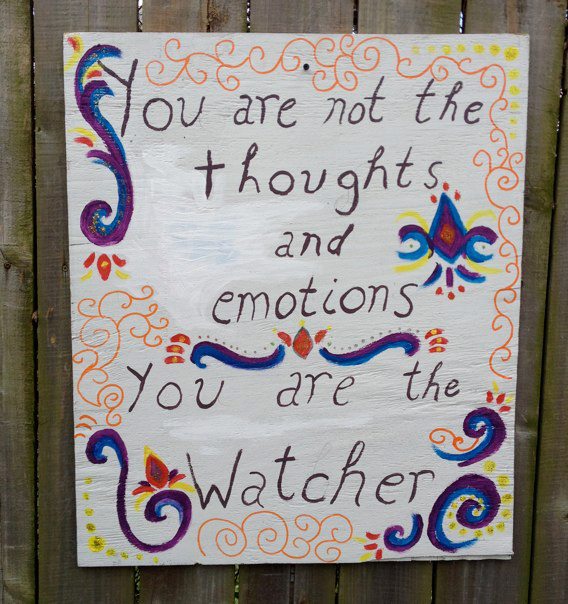
In meditation, I often invite students to imagine their thoughts and emotional states as clouds in the sky. If we watch the sky, the clouds will change in shape, size, color, and their very nature. A clear and bright day can turn to storms very quickly. Just like weather, even though they may come in seasons and patterns, all our thoughts and emotions are passing through. Their fundamental nature is to be temporary. If we can visualize our thoughts and emotions as the weather above us, and our Selves on the ground watching, we are able to understand more clearly their true temporary nature. Seeing this, putting our Selves in the position of an observer rather than as helpless to the storms, we take away their power. We relieve our Selves of the work of constantly blowing the clouds away or running from them. Often, that discomfort we encounter about being in a yoga class, about what we “should” feel like, is us trying to control our inner weather, rather than sit with it and allow it to be temporary.

Another way to think of making space has to do with the “good” thoughts and emotions. I have mentioned my common thought pattern of minimizing, or discounting/devaluing the positives. It’s common in a lot of people (me) to have a thought like, “I look GREAT today!” or “I did an amazing job!” and instantly turn away from enjoying that feeling. “Yeah but yesterday you had that awful zit,” or “Big whoop, it’s ONE day, it’s not like you just look great.” “Not so amazing considering how you fumbled through the entire thing until the very end.” Maybe we turn toward a negative expectation of the future. “Yeah but the next project is gonna be a real shitshow, you know you’re in over your head.” For me, in all of these cases, maybe it comes from resenting the temporary nature of the good feeling so I cut its time short. Maybe I would rather pretend that feeling good doesn’t matter to me than accept the truth that feeling good will pass, just like that bright clear sky will eventually cloud over. What if making space also means opening up, softening to the full experience of our joy, beauty, happiness, power, and prosperity? Accepting it, being in those moments while they last, allowing them too to be impermanent?

I’ll part on a favorite Buddhist quote that I first saw in 2013 at the wonderful Louisiana Himalaya Association in New Orleans, LA. I loved it so much I took a picture.

I breathe.