

I. Baking and a Behavior Science Conference
I love to bake, and I bake a lot of different kinds of things. Some years, I have made Christmas cookie boxes with a dozen different shapes, colors, and textures to choose from. I like to make classic Southern caramel cakes with crunchy-creamy candy frosting. I recently went on about a two-year custard journey, and can now make everything from loose custard for trifle, to set bavarois. I have yet to master the almost-fatless genoise sponge, but I’m working on it. And because of all my baking has taught me, I have decided that every person is a cake. We never do finish baking or being decorated, but inside, we are each a gorgeous, delicious cake that everyone is overjoyed to have at the table. Maybe you already know what kind of cake you are—tiered and adorned, frosted or sugared, damp or airy? Do you feel more like a pie? The point is, you’re a cake (or a pie or a perfect bread), and hopefully by the end of this blog, you’ll have some ideas about how to adjust your special recipe to make sure you bake to your fullest potential.
In July 2019, the LaMiss (Louisiana-Mississippi) Affiliate Chapter of the Association of Contextual Behavior Science Conference was held at the University of Mississippi. This conference meets every other year, and two of the authors from my Resources post are members. The 2019 conference was created as a tribute to Dr. Kelly Wilson, retiring as Professor of Clinical Psychology and all-around outstanding professor and mentor to a number of talented therapists, counselors, and behavior scientists. It has been a pleasure over the past more-than-a-decade, to get to know Kelly and his various students and former students. While enjoying these humans in my lucky world, I have absorbed and sought out a lot of information about psychology and behavior science. These people, beginning with Kelly, are the reasons I learned what ACT (Acceptance and Commitment Therapy) is, how I came to (partly) clicker train my cats, and why I am so passionate about maintaining the mindfulness and meditative components of my yoga practice. The conference was local and affordable, and they asked me to teach a yoga for attendees, so I also attended the first day of presentations.
At the conference, I sat in one session in which former-student lab partners who now work in a variety of academic and practical disciplines discussed their ongoing connections and collaborations with each other. They feel better supported in their work by maintaining this particular community and its analytical goals and values. In another session, the speakers discussed the ways in which a university “behaves,” including its communications with students about their academic experiences and requirements, and its ongoing compliance practices with Title IX. One speaker constructed the climate crisis and other exploitative and extractive world conditions as fundamentally human behavior–and therefore solvable–problems. It’s one of the most heartening things I have heard in quite some time. Finally, I went to a session of applied Eastern practices. We did a great Durga chant with some therapists who use sound and singing in their therapy practices. They began by offering gratitude to all the people who contributed to our being there that day–the scientists in their field, including all those not present (women, people of color, the scientific knowledge of the African continent that was lost when the Library of Alexandria was burned), and the indigenous Chickasaw people on whose ground we stood. It was far from my stereotype of an academic conference, and absolutely no one appeared to me to be worried about who they needed to influence or network with. Maybe that had to do with it being a very loving send-off theme, but the affinities between people were obvious. This affinity only intensified at the most mutually enthusiastic and dynamic bar karaoke I have ever seen.
Because of everyone who ever told me stuff or wrote stuff that I read, or caused me to go look some of this stuff up, here is my lay person’s offering of understanding of Contextual Behavior Science. With love, gratitude, deep breaths, and citations.
II. CBS Is Baking
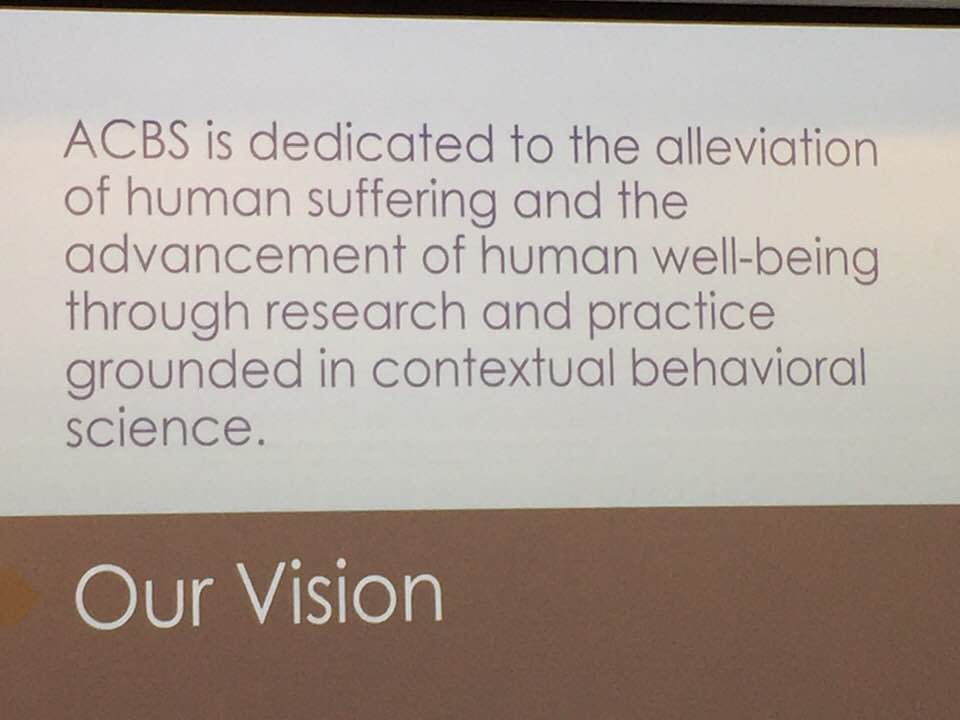
“Contextual Behavior Science” is a lot to try to explain or to understand. I highly recommend exploring the information available at the Association for Contextual Behavioral Science website, linked here in various quotes.
Contextual behavior science rejects the idea of absolute truth, and does not assume any point of view as “objective” or as having been created from a neutral environment. The best way I have come up with to illustrate the difference between a “contextual” behaviorist and what I would call an “objectivist” (meaning believes in absolute truth, not referring to any specific philosophical system) is this baking analogy in which we are cakes. (If the baking part seems confusing, watch The Great British Baking Show over several seasons, for the baking information and demonstrations of the kind of adaptability CBS folks call “psychological flexibility.”)
If asked to describe how to bake a cake, a pure objectivist might recite a highly precise recipe, insist on measuring with a kitchen scale, and might say “This cake will be fully baked in 30 minutes at 350 Fahrenheit.” By contrast, a contextualist recognizes that high altitudes and other conditions affect all the baking processes. A contextualist might say, “This cake will be fully baked in 30 minutes at 350 Fahrenheit, except above 3,500 feet above sea level, in which case several adjustments to the recipe, including temperature and baking time, must be made” to create the exact same cake. Like altitude, humidity affects the amount of flour required to make dough, and high humidity can make candy recipes impossible to make. The chemical processes and changes the ingredients go through to become a cake can be described in empirical terms, but to correctly induce and control those processes to make the kind of cake you want, knowledge and adjustment for the surrounding conditions (the contexts) is required. Bakers have long been studying contexts and finding flexibility in order to create scrumptious, desired outcomes. To a contextual behavior scientist, perhaps we are each different kinds of cakes, all trying to bake to our most stunning and delicious potential. But different cakes are made from different things, and they need different temperatures and cook times and pans and volumes, plus our individual altitude and humidity conditions can vary drastically.
III. Behavior Analysis and Controlled Contexts
“[B]ehavior analysts simply believe that people learn how to think, reason, plan, construct meaning, problem-solve, and more through interactions with their natural, social, and cultural environments. Thus, behavior analysts attempt to identify aspects of the manipulable environment that influence the occurrence, incidence, prevalence, or probability of both private and overt psychological events.” –Functional Contextualism, ACBS
The history of scientific behavior analysis, and modern behavior analysis, were heavily influenced by B.F. Skinner, whose experiments with animal behavior created the concepts of operant conditioning, reinforcement schedules, and other constructs of behavior and learning. From the B.F. Skinner Foundation, “The experimental analysis of operant behavior has led to a technology often called behavior modification. It usually consists of changing the consequences of behavior, removing consequences which have caused trouble, or arranging new consequences for behavior which has lacked strength.”
Behavior analysis is about experimenting with specific analytical goals in mind. Skinner’s most famous method of behavior experimentation involved “Skinner boxes,” which were very small, contained environments in which the stimulus, response, operant, reinforcer, and reinforcement schedule could all be identifiable and manipulated in controlled ways. “A hungry rat is placed in a semi-soundproof box. For several days bits of food are occasionally delivered into a tray by an automatic dispenser. The rat soon goes to the tray immediately upon hearing the sound of the dispenser. A small horizontal section of a lever protruding from the wall has been resting in its lowest position, but it is now raised slightly so that when the rat touches it, it moves downward. In doing so it closes an electric circuit and operates the food dispenser. Immediately after eating the delivered food the rat begins to press the lever fairly rapidly. The behavior has been strengthened or reinforced by a single consequence.” Also from The B.F. Skinner Foundation
These experiments are hugely important to our understanding of how behavior operates and what can be done or changed to influence and shape behavior. Behavior inside the box is just not the whole story, because it is the study of behavior in a highly controlled and limited context. Contextual behavior science is dedicated to bringing precise, scientific understanding to the many complex contexts in which behavior occurs “in the wild.” Humans and animals behave in very different ways in different kinds of “boxes” just like flour, butter, eggs, and sugar behave differently above 3,500 feet above sea level, in high humidity, and depending on the ingredient proportions and mechanical processes they are subjected to. A great example of an experiment on behavioral differences in the same animals, in different kinds of boxes, is the Rat Park experiment. Rat Park was all about observing physical addiction in different contexts. Rats, which are naturally social, intelligent, and curious, were isolated in conditions that had previously resulted in physical addiction to a morphine liquid. Once addicted, they were moved into Rat Park, where they had social access to other rats, and free access to play and stimulation. They had free access to food, water, and the morphine liquid. Once they moved into Rat Park, the addicted rats weaned themselves off of the morphine liquid, preferring it less and less over time, and tolerating their withdrawal symptoms in order to participate in their healthy, social, stimulating environment. This contradicted the accepted framing of addiction, the belief that “once an addict always an addict.” An addict in an appropriately supportive environment may have everything they need to break free from their substance of choice.
IV. Behavior Analysis and Private Contexts
As it says in the basic definition, behavior analysis includes analysis of both “private and overt” psychological events. Part of the full picture of behavior, behavior modification, and retention of any modification, includes the private psychological events within the individual. This is individuals relating to their own emotional states, their own perceptions of their relationships and lives, their own perceptions of their own thoughts and mental states, however well or badly, however consciously or unconsciously they do those things. Most individuals are not the most reliable narrators of their own private psychological experiences, but we don’t have the most perfect or precise tools to “objectively” measure them either. Even in the world of “physical” experiences, individuals have notoriously idiosyncratic and varied experiences of physical pain. Still, to study behavior as it actually occurs “in the wild,” we must have somewhat systematized ways of analyzing and understanding these private, internal experiences in others. This is maybe the part where the mixed cake goes into the oven, for better or worse, and the protein and sugar structures behave in the way they behave, under the given conditions.
Carl Jung worked in an area of psychology called psychoanalysis. He was not a behavior analyst, and he never conducted experiments in boxes or on animal behavior (or in the kitchen, that I know of), but he explored and articulated important contexts within the human mind and constructs of the subconscious. He did amazing work developing an understanding of what “unconscious” means, and of archetypes as a kind of brain structure through which information is filtered—consciously and unconsciously—to create meaning in the world around an individual, for example.
“’Everything of which I know, but of which I am not at the moment thinking; everything of which I was once conscious but have now forgotten; everything perceived by my senses, but not noted by my conscious mind; everything which, involuntarily and without paying attention to it, I feel, think, remember, want, and do; all the future things which are taking shape in me and will sometime come to consciousness; all this is the content of the unconscious… Besides these we must include all more or less intentional repressions of painful thought and feelings. I call the sum of these contents the ‘personal unconscious’.
“Unlike Freud, Jung saw repression as just one element of the unconscious, rather than the whole of it. Jung also saw the unconscious as the house of potential future development, the place where as yet undeveloped elements coalesced into conscious form.” –Journal Psyche, quote by Carl Jung
Most striking to me, for its relationship to contextual behavioral science, is Jung’s description of the collective unconscious.
“‘[T]he term archetype is not meant to denote an inherited idea, but rather an inherited mode of functioning, corresponding to the inborn way in which the chick emerges from the egg, the bird builds its nest, a certain kind of wasp stings the motor ganglion of the caterpillar, and eels find their way to the Bermudas. In other words, it is a ‘pattern of behaviour’. This aspect of the archetype, the purely biological one, is the proper concern of scientific psychology.‘
Jung believed that these blueprints are influenced strongly by various archetypes in our lives, such as our parents and other relatives, major events (births, deaths, etc.), and archetypes originating in nature and in our cultures.” –Journal Psyche, quote by Carl Jung
In other words, Carl Jung came up with language to understand our private brains and Inner Selves. Taken alone, Jung’s work doesn’t lend itself to the kind of rigorous experimentation that reliable behavior analysis requires. But he articulated frameworks—contexts—within which and about which psychotherapists and individuals can systematize and describe behavior-influencing contexts like culture, religion, and the things outside the immediate consciousness. And maybe, too, he simply didn’t have the language or analytical tools to describe what he was doing in his behavior experiments with his patients. This blurb from a 1999 Journal of Applied Behavior Analysis has his patient giving herself gradual exposure to being on a train, with the support of a chauffeur, to try to overcome her crippling fear of traveling. “Was Carl Jung A Behavior Analyst?”
V. The “C” In CBS
“Contextualism” refers to the worldview or philosophy that undergirds the assumptions and practices of contextual behavior analysts. “It is a world view in which any event is interpreted as an ongoing act inseparable from its current and historical context and in which a radically functional approach to truth and meaning is adopted. “Contextualism” refers to the worldview or philosophy that undergirds the assumptions by contextual behavior analysts.” –About Contextualism, ACBS
“The knowledge constructed by the descriptive contextualist is personal, ephemeral, specific, and spatiotemporally restricted (Morris, 1993). Descriptive contextualists seek to understand the complexity and richness of a whole event through a personal and aesthetic appreciation of its participants and features. This approach. . . can be likened to the enterprise of history, in which stories of the past are constructed in an attempt to understand whole events.”– Descriptive Contextualism, ACBS
If we know that context matters and is fundamental to behavior, maybe we also know that the right box can successfully change or support changes in people’s behavior. As inferred from the Rat Park experiment, and observed in many, many humans, people can be somewhat successfully treated for addiction in in-patient environments. Many people who maintain sobriety in the in-patient environment will express their desire to retain the new behavior pattern. And we know that most people treated for addiction will relapse once outside the in-patient “box” and behaving within their home “box.” We know that many people can lose weight or keep a vegetarian diet at wellness retreats, but they are less likely to maintain the weight loss in their home “box.”
I recall an example of thinking like a contextualist from Kelly, who offered some thoughts on the stereotype of the “hyperactive child who needs ADHD medication.” Identifying “problem” behavior patterns and “correcting” them with medicine might sound perfectly rational. To a contextualist, it’s not so direct or clear-cut. To paraphrase, “How much sleep does this child get at night, and do they have a regular bedtime? What, and at what times of day, are they eating? Do they have adequate opportunities for play, exercise, and outdoors time?” Etc. It isn’t an anti-medication stance, it is a “treat medical problems with medication” stance. A contextual behavioral approach might see medication as one of many manipulable ingredients that influence behavior. A contextualist is less likely to default to medication as the primary or most important ingredient to focus on. Whether establishing desired behavior, maintaining desired behavior, or reducing/eliminating negative behavior, contextualists demand to look at the whole.
Understanding “current and historical context,” and “truth and meaning,” and especially descriptive contextualism sound Jungian to me. But it’s impossible to apply his ideas about internal human processes in behavior analysis without a highly structured methodological framework, a la Skinner. It seems to me that these two spheres of understanding can each illuminate the other. Jung articulated language for common and shared internal perspectives with his work describing archetypes, religious symbolism, and family relationships. His language and conceptual tools can help describe similarities and differences between people’s internal experiences and processes. A behavior analyst can sort and categorize (human) research subjects’ or patients’ experiences to better understand what parts of those internal environments are manipulable. Skinner’s work made it possible to create precise, scientific ways of understanding Jung’s religious icons, archetypes, and family relationships, and their influence on observable behaviors, from thought patterns to external actions.
VI. Back to Baking
Angel food cake needs an ungreased pan and to hang upside down to cool. Genoise sponge is partially cooked over a double boiler before baking. Some cakes are supposed to come out very damp and cool inside the pan, and some are supposed to have a crack over the top. We have greater capacity to understand what kind of cake (or pie or perfect bread) we seem to be if we understand our own personal ingredients, and if we know how our environment influences our bake. Because of contextual behavioral science, each of can learn the tools to become the most stunning, delicious version of our Self that is possible.
 The Sassafras Cottage